
 |
Karate Do
Around 520 A.D., Daruma (Bodhidharma), the founder of Zen Buddhism, was teaching at the Shaolin Temple (Shorin-ji) in the Hunan province of China. Seing that many of his disciples lacked the endurance necessary to follow his strict program, he originated a method of physical training called Ch'uan Fa. This was introduced to many parts of China, and later came to be called Shorin-ji Kempo. Over the centuries, many different styles developed. Shorin-ji Kempo, later known as Kung-fu, was imported to the island of Okinawa in the southern part of Japan during the T'ang dynasty (A.D. 618 - 906). Here it was combined with native martial arts and underwent tremendous development. For long periods in Okinawan history, common people were refused the right to carry weapons. Thus, they had to heavily depend for their defense on the art they now called karate, which they learned in secret and passed on from generation to generation.
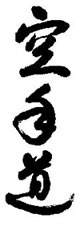
Initially, karate was written with two Chinese characters meaning Chinese hands, Kara being the major province of China, and Te meaning "hands." Gichin Funakoshi changed the first character from Chinese to Empty, thus forming the modern term for Karate - empty hands. The word "empty" can be interpreted at two levels: one as meaning weaponless, and a deeper one signifying the fundamental teaching of Zen: empty yourself to achieve unity with the Whole. Funakoshi Sensei also coined the term Karate Do, meaning The Way of Karate. The life of this gentle, modest man was guided throughout by the principle that karate is a means of perfecting and strengthening the human character. |
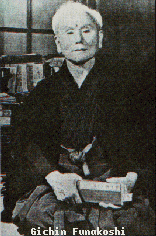 Gichin Funakoshi, the
founder of Shotokan, was born in Shuri, Okinawa in
1868. As a young boy, he trained in Shuri-te (with
master Azato) and Naha-te (with master Itosu), both
traditional Okinawan styles. A blend of these two arts
was then brought by Sensei Funakoshi to Japan, when he
was invited in 1917 to perform at a physical education
exhibition sponsored by the Ministry of Education. He
was asked back several times in the following years,
including by Japan's emperor in 1922, at which time
Sensei Funakoshi decided to teach and promote his art
in Japan. He eventually helped found the
Gichin Funakoshi, the
founder of Shotokan, was born in Shuri, Okinawa in
1868. As a young boy, he trained in Shuri-te (with
master Azato) and Naha-te (with master Itosu), both
traditional Okinawan styles. A blend of these two arts
was then brought by Sensei Funakoshi to Japan, when he
was invited in 1917 to perform at a physical education
exhibition sponsored by the Ministry of Education. He
was asked back several times in the following years,
including by Japan's emperor in 1922, at which time
Sensei Funakoshi decided to teach and promote his art
in Japan. He eventually helped found the